Autumning

Autumning; v. the transformation of things in the natural world from their summer to their autumn selves.

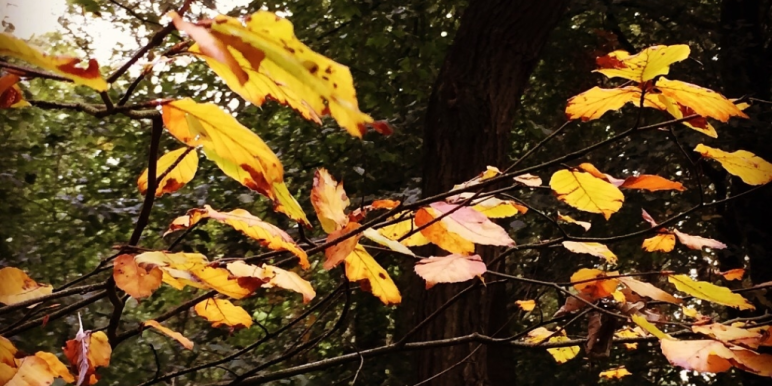
Nan Shepherd wrote in The Living Mountain that when others talked the mountain – which was her constant companion and to which she was almost mystically attached – was silent. I’ve expressed a similar sentiment myself: to walk in solitude is best. And yet. Today we are companionable and quiet together as we set out into Strid Wood at Bolton Abbey in Wharfedale, letting the trees and the deepening cut of the ravine speak for themselves. Only occasionally do we interject our wonder. The russeting landscape does not need us to interpret for it; but occasionally wonder with the force of an electric charge asserts itself with the need to be stated aloud, as though in sharing it between ourselves we lay claim to our unified experience of this magic.
Sept_BoltonAbbey8

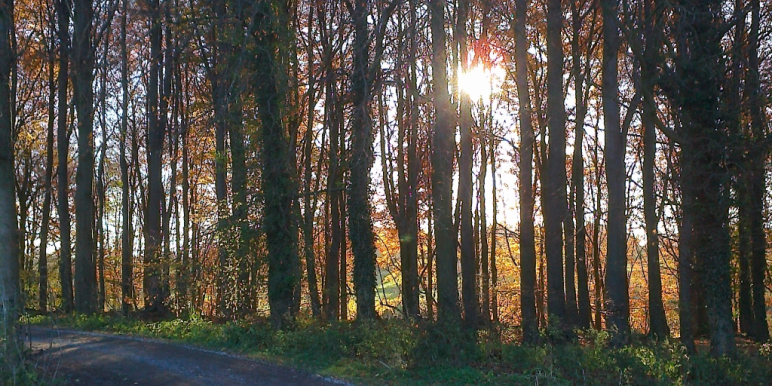
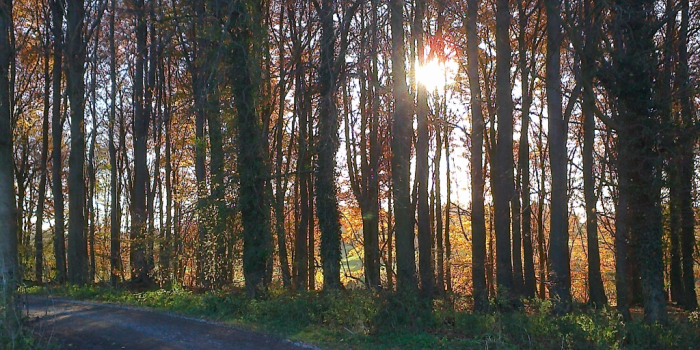
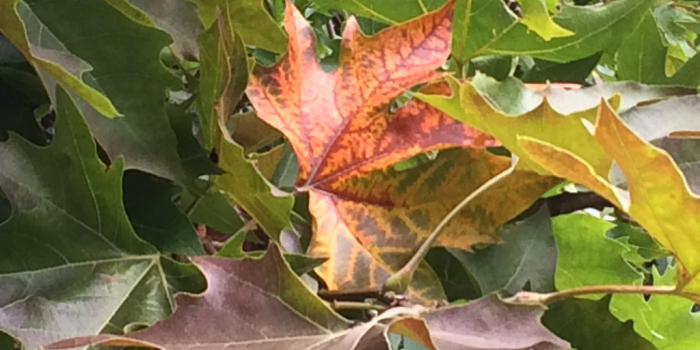
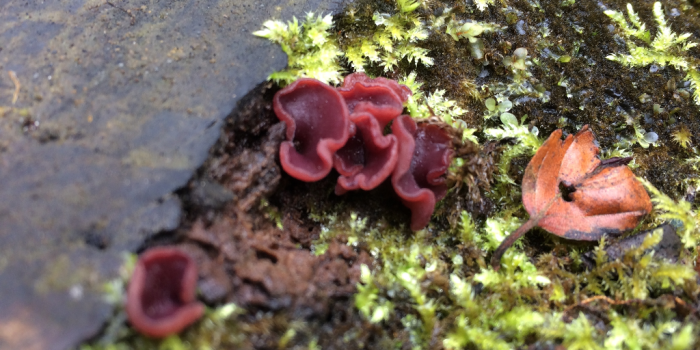
It is the morning preceding the autumn equinox and night and day exist in fragile and temporary harmony, split perfectly even like two halves of a ripening gourd, an uneasy truce until day starts its slow decline and we, grudgingly, will get up to darkness and our evenings will arrive with inky black before their time. Today we each walk with one foot in summer and one in autumn; looking forward and also behind. The outermost leaves of the crowns of the trees are flushed in eager reds: their chlorophyll gone, revealing their true colours. Those leaves further in are masked, for now at least, by their top-lofty canopies and are able to hang on to their green: summer’s final whisper. Sharp rot, leaf-decay, wood-smoke, the darkly astringent tang of fungi pushing up through the earth. We take the woodsy taste of it deep into our lungs, accept autumn is in the air and that summer has been lost until next year.
Sept_BoltonAbbey5

We do not do any of this deliberately; we are none of us aware that today marks the equinox until later reading an article about it – but our talk is preoccupied with the autumning of things: with the turncoat leaves, their deaths around us (and they do die brilliantly in this late-summer, autumn-precocious sun), and the chilling air that has brought a heavy sparkle of dew to the floor of the valley: silver underfoot.

The night has been cool and cloudless before us and I think to myself that the sunrise over the top of the valley will have been luminous as mother of pearl. The sun will have broken over the treetops in arcs of pale splendour and, for an exquisite moment, the night-dews will have borrowed its brilliance. The birds which noise to us now (the musical trilling robin, the shrilly barking crows that wheel overhead, the wagtails) must have started their cacophony of song in that thin morning light. A grey wagtail dips exuberantly in its distinctive flight over the sun-meshed water on our left. Happy to be about its day-flight; happy to be buoyed up on the autumn breeze.

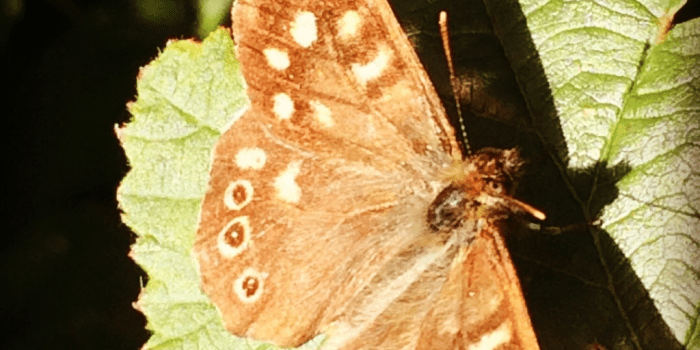
We are lucky that the sun has lingered to throw gold upon the changing trees before us; trees that clump together and march the sides of the valley, guiding us up through its mysteries. The sunlight is not constant but strikes here and there through the leaves as, timbered on either side, we ascend with the valley mostly hidden from view. With the thick marches of trees conspiring to keep our destination a secret from us, and the way winding round the natural depressions and inclines of the land, our business is simply the path, the bank with its hospitable roots, the tangle of which wasps and other creatures have made homes in, and keeping a weather eye on the sheer treed drop to our left. At the same time I am attentive to the minutiae of life around me. Sunlight catches at the clapping wings of a speckled wood butterfly, charmed out of hiding by the promise of late-summer warmth on its wings. Finally it settles on balsam. How majestic it seems, propped up on its forelegs, its abdomen flush to the leaf, its wings spread to their openest extent, as though presenting itself for the sun’s inspection. There is deep contentment in its manner. Speckled woods habituate stands of oak in particular.
Sept_BoltonAbbey12

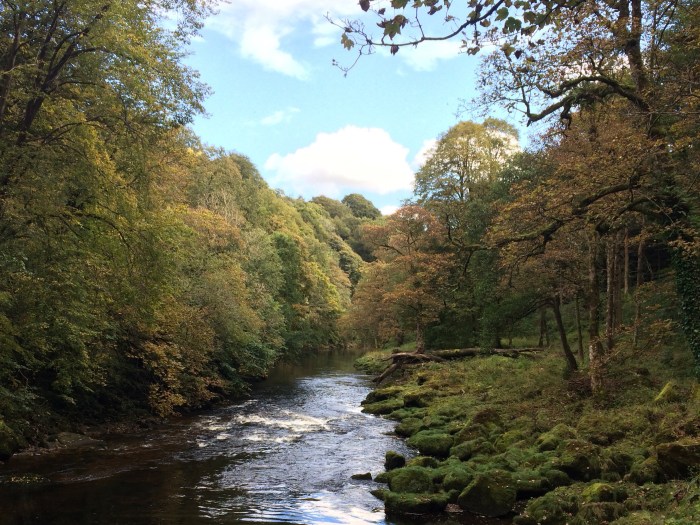
Attuned to one another’s particularities of gait and tolerances of various gradients, we pitch and slow in silent allowances for each other as we go; as the ravine cuts a little deeper and we climb a little higher; our lungs are tired bellows at labour. The river Wharfe is a constant clamouring companion and we cannot help but let our gazes fuss at it as the path moves us inexorably up and away from its noise. Exerting its magnetism, it draws our eyes downwards between the breaks in the trees, thundering to be heard. On top of the view – on top of the world – we admire the silken silvered ribbon of the river below as it winks and glows between the trees. More and more of it will be revealed over coming weeks as the trees lose their leaves to its flashing flow. The river stretches wet fingers as it goes to creep up rocks, slip over pebbles, and catch at leaf and branch to bear them seawards.
Sept_BoltonAbbey9

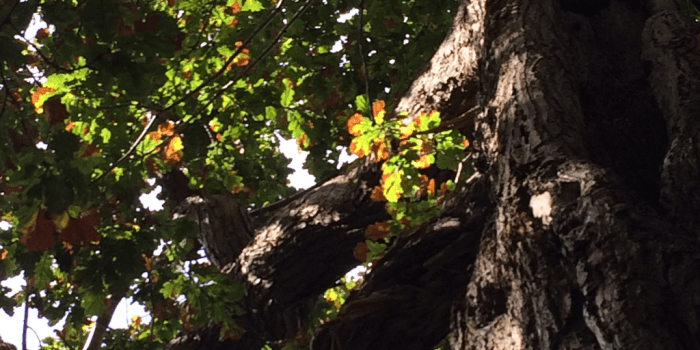
Sessile oaks abound in Strid Wood and autumn is inaugurated in them in strange ways. With none of the haste of the ash, which discards its leaves prematurely and greenly every year, the oak blots its leaves with yellow blisters as though stricken; the edges of the blisters blacken, or in some cases red and orange touch it to lend more of autumn colour to its decay. Over weeks of weathering the blisters increase until gradually the whole leaf is taken over by motley colours, and even then it is slow to fall away. It is a haphazard kind of autumning. More often it is the twiggy bracts – this year’s growth – that fall off in winds and weathers, taking the reluctant leaves with them. I see only a few fallen oak leaves on the path; many more are the acorns whose surprisingly loud drops are an integral part of the forest’s chatter at this time of year.
img_5634

The river Wharfe is parented in Langstrothdale, its source the shake holes of the Yockenthwaite and Horse Head Moors. The narrative of the river is one of increase and drama: from shake hole springs to becks, from becks joined to form hill streams, from hill streams converging into the river. The name Wharfe derives from the Old English weorf or the Old Norse hverfr meaning winding river. And it does wind in an almost leisurely manner through its deep dale valleys, turning back on itself, noosing and curving with serpentine, sinuous skill. Until the section called the Strid between Barden and Bolton Bridge. Here it kills.

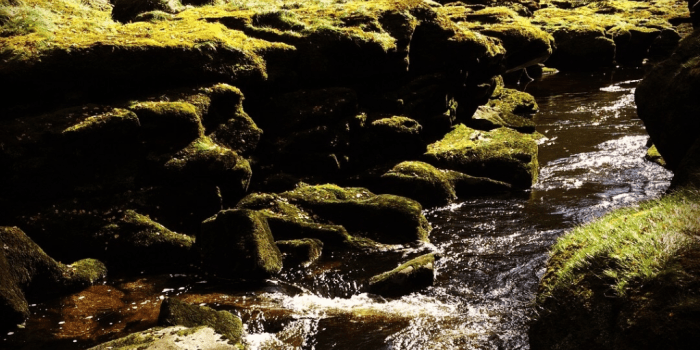
Strid is a name derived from the Old English stryth, meaning strife or turmoil. It is the section of water where the river tightens its belt and cheats its volume into a squeeze that’s sized only a pace wide. Here the pace of the river grows faster, the momentum greater, as it twists and dashes itself down the ravine.
Sept_BoltonAbbey2

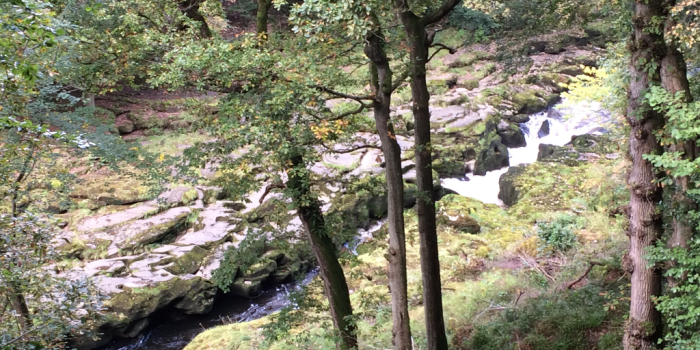
We arrive at last at the water’s side. On the bank’s sharp brink of rock I cram myself into this moment by the water, let it throb in my veins. The river is both drama and danger; people have died here. Perversely quicksilver and beautifully terrible. Its breath is in the air and on the moss-fringed rocks that suck thirstily at it. These rocks that line its passage have been scooped out and undercut by it in smooth crescents as it gushes downstream. A treacherous combination seam of fluid and organic matters colliding. The scalloped edges have their secret pools and hidden depths between. They say that it is 9m deep just here, carving out the limestone shelf beneath it, and the undertow strong enough to keep an Olympic swimmer under. The Wharfe has narrowed too quickly from its 30ft width higher up the ravine to this narrow stretch of the Strid. My gaze cannot rest for long on the water without being pulled upstream to the source and thunder of the course over its rocky bed.
Sept_BoltonAbbey10

I dwell for a while in a micro world: I pick a bubble to follow but it’s futile and I lose it; a single leaf falls slowly and with the grace of a bird; the greenest moss I’ve ever seen tickles the tips of my fingers. I let Autumn with all its burning majesty pass through me as the woods exhale their leafy crop on long-held breaths and the river blows out its fury.


Golden Glen

As seen in the October 2017 issue of Dalesman magazine.

On this late October evening the Glen beckons, for after many pilgrimages to its heights I know some of the delights that await me up there. This is the time of year when I most want to walk; when wanderlust is eloquent and insistent indoors and the autumn itch to pitch into the changing world of dapple-hue is unresolvable until treading through – and smelling – rich leaf-mould.

Golden_Glen1

I set out into a golden, wind-buffed dusk, which is arriving almost imperceptibly earlier than those of the preceding week: this hasty drawing on of the setting sun a signal that the year is preparing to clamber back into its gilding husk, to out-winter coming weathers. Not yet, I appeal with my footstep. I feel the merest nip of chill in the air at the end of my nose and in the tips of my fingers as I plot my course through the same-yet-not-same Saltaire village streets. The paving slabs are wet with dews – step-slicking – and, with the underbelly of the sky burnishing before my eyes, I fold myself into the nap of the wind and walk up through the wood’s unburdening of itself. Under oaks wrack-bent and twist-thrown, their leaves on the burn from yellow to auburn, the setting sun lights – there! – a strike as of a match, and sets the forest floor to fire. I scoop-gather some beech leaves as I go in bright but not yet brittled sheaves turned from green to red-gold.

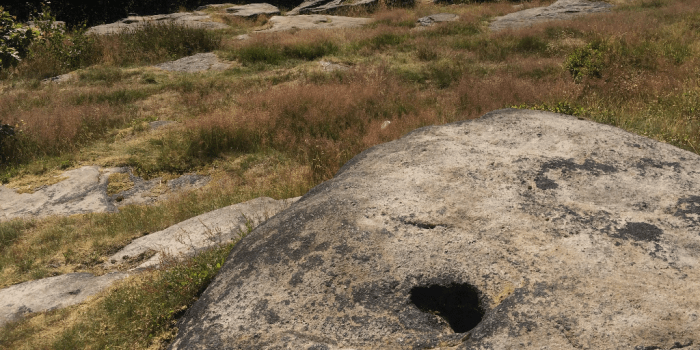
Emerging from under the trees out onto the Shipley prairie of grasses, bracken and old ragged ragwort, I farewell my warbler companion who has followed my steps, always invisible in the depths of the trees, with his ooo-weet! ooo-weet! My steps plant golden into the old-grass ground and I catch my first sight of the dark monumental rocks laid down all-accidental-like in the thousands-of-years-ago glaciation. Rocks which up-rear themselves and fit the land between them, then fall off sharply, lipping the wooded ravine with their precarious-seeming precipices. Like the rocks, autumn up here is crisp and elemental: the wind flays the turf skins between and over the erratics in suck-cheeked frenzies, creating lips of grass that are trip-trickery to a walker’s boot. The bracken, bled of its summer green, is a brittle untidiness of antique rust, an ochre-brindled crust upon the earth. I have anticipated the desiccation of the bracken since walking the summer path between them, metres high, in arm-hoisted surrenders.

Golden_Glen2

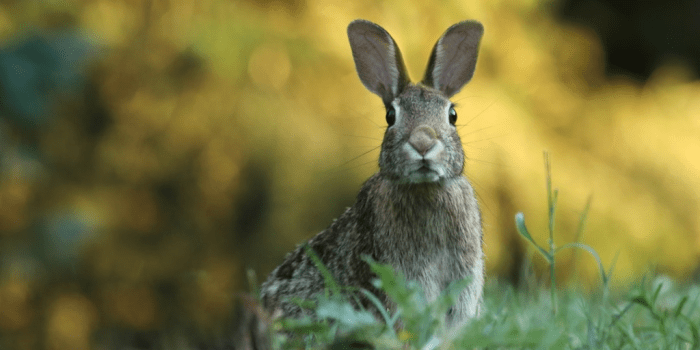
All recalls summer; all looks on to winter. Autumn mixes a little of both in its strange alchemy. Scuff-footed, I walk these ancient stones towards the horizon, the sinking sun striking the clouds with fire behind me. My eye is drawn up high to a banking flock of birds – too high to tell what they are – but perhaps some of the number who leave us to our winter devices each year in elective desertions for warmer, more abundant climes. As my eyes complete their circuit, a sudden start caused by my step from grass to stone draws my gaze towards the fading heather. A shadow enlarged by the low-setting sun. Can it be? It is. A hare. A creature made to stand and stare at; all its energy gathered into its sprung limbs; its unearthly gold-rimmed eye daring my step. But I am stock-still in amazement at this late-in-the-day gift. I will not shift until it does. Don’t mess this up. Its ears are alert to me, upright and sun-bright in the long light of gloaming on the Glen; its tawny fur, caught by the rays of the dying sun, is part-scruffed in places from amorous boxing skirmishes. I hold its gimlet eye for a heart-stopping few moments, and then it musters in a flash and darts into dusk.

Golden_Glen3

This is why I have chosen this end of the day – when the light is sunken, shadow-casting and there is magic at play over the trees. As I stop on top of one of the giant boulders overlooking the glen, made purblind by the wind whipping about and through me, I begin to feel the day slipping to its close. The trees stretched beneath me are shucking their summer clothes: sycamore propellers skate and skirl downwardly; acorns join the beech mast carpet; everything ensures its progeny. And somewhere beyond me, a hare leaps home.


Night Sky

Stars do indeed twinkle, I have seen them:
pricked into the blue canvas of the sky,
a flicker of pearl pulsing on the eye
out of the deep velvet dark –
winkingly –
with each its own lustre of light.
The rite of dusk so many nights
unobserved under cityscape smudges
is here piercingly clear –
on the wild of the moorland,
in thick country darknesses.
I fiercely wonder at your brilliance –
and try to claim your light –
eyes full wide
focusing the night.
But I do not know you – you,
light years beyond my ken,
hanging like a symbol or a metaphor
above my head.
You’re dead above me,
your light the last dying glimmer
of your living glamour.
I only know you in your
death throes
so far removed
from the everyday.
O let me look at you this way –
dying beautifully,
eternally,
where I am not known.

The owl’s cry is a tremor
of my wonder,
and voices it better.

Names trees give themselves

Rain lashes through a whimple of cloud. Days of dirty skies have succeeded one after the other lately and whenever I look out of the window with a fool’s hope, the rain whitens everything with its diagonal, dashing fall, making a mystery of the view: a veil between me and the world. My slate-grey mood prowls withindoors to the tattooing droplet-driving dance. Everything is variously damp and dank-smelling inside as well as out and the house is, for a time, unhomely and I a fidgeter indoors. But, after a morning’s fall from a granite firmament, now the belt of rain-pall has slackened and I step out into mizzle — a good word — which is to say a something or nothing rain; half-masted between a mist and a drizzle; short-changed out of full onslaught; a cobweb of wet on the eyelash; rain’s last resort. The onomatopoeia of ‘mizzle’ suits the barely-embroidering dew of it on my skin and clothing. By using it, I think with a deft complacency, I am keeping this scarce-heard word alive, breathing life back into it as it wets my tongue. Mizzle. It’s one of many words we’re helping to lose through the slow erasure of non-use.

Hand in glove with the elements, my walking today is warm and muggy — almost cosy — in my spangled mizzle-sheen and I lift up a round face into the lea of where I think the sun might be, there in the opaque, blinding white halo. The valley has been washed by heavier morning showers than this and now the very last dregs in the sky-cup are filtered through a fine cheesecloth of cloud leaving only this light haze to drowse upon the grass banks and the willowherb. Its speckling on my skin is almost pleasant; a light refreshment after the stale indoors. I’ve timed my walk with the weather and, in a sudden access of exuberance at the lessened rain, the postman hulloes me and calls that I’ve brought the sun out with me. I am word-stumbling in denial, but he’s curiously adamant as though I had the power — a weather-charm weaver — and, cheerfully amused at the thought, I press on.

Looking out across the valley as my steps draw me down into the crease of it I see — whoosh! — a swift performing its sky-dance, its black wings the merest lilting on the wind. Insects must be drawing it to thread itself back and forth across the scree of cloud, and with what a swooping joy it cleaves the air! Such effort for just a mouthful on the wing, I think, hoving onward though back-glancing at its dipping display. Around me, nature is turning herself to the business of fruiting. Where once were the delicately white-anthered blossoms of the hawthorn, now berries thicken in perfect curvatures; apples are approaching shop-worthiness on the tree; and the rowan berries are already choleric with red, their orange anger earlier than ever this year. I see a whole cycle from flower to fruit on one bramble bower: the pink-white rose-like blossoms, the green fruit still tightly unripe, and the rich blood-black berries, as heavily hanging as antique ear-bobs. It is a worry what the birds will do as a result of this too-soon bounty when the year draws on to dearth, and I send my thought up with supplication: not too hasty, autumn. As if drawn by these forebodings, my eye is caught on goose-stepping lines of black rooks and crows patrolling the playing fields for worms. There is something morbid about their presence as they move forward in forensic searches, like a police line punctuating the green with their funereal sweeps.

The top of the Glen shows itself dazzled and imperfect; the stone houses rendered softly indistinct; and the tree-bank losing its sharpness. The sun, making a brief appearance, sets the haze to silver and I know that somewhere there must be a rainbow, beyond my sightline and beyond my gift today. Trundling on down the hill, my steps mechanical having walked this path so many strides now, I am headed (I know it with sudden clarity) for Hirst Wood: for just-in-case cover; my native tree-patch; nature’s ancient thatch in serried rows of leaf upon leaf. Sometimes my feet draw me down to the wood with the instinctive understanding of sole to soul.

Hirst Wood emerges as a shadow on my left, its darkling silhouette of beech, birch and oak hugging the side of the Leeds Liverpool canal; occasionally dipping a toe in it. Now that I have the shortcut by Caroline St and Dallam Ave by foot-rote, the prospect of being ensconced, enveloped and covered over with green is only ever a mere 10 minutes’ walk away. As with other ancient woodlands, admittance to this hallowed, treed sanctum has been bargained for with many walkers’ feet. If we stopped turning in at the side of Hirst Lane, it would forget us and close the gap over again with irrepressible green as though we had never been here at all; never pressed the leaves with our feet; nor watched the squirrels’ scampers; not heard the invisible birds’ calls. No respecter of people this wood, and I am heartily glad of it.  I tuck myself away into the fold of its trees, my steps cushioned on a thick layer of rich black loam: good growing soil that roots you if you stand still for too long, but pleasant to push a toe into. A complicated black, textured and coarse, with bits of bark and moss returning to the earth. Centuries of leaf mould worked over by worms, beetles and mud-boring bees have connived at this good grounding.

I crane my neck up in an arc of longing at the top-lofty beeches and birches; their branches crackle-glazing the sky in stilled squiggles; their cover giving me dry underfoot. Their arms uplifted are greedy snatchers at the hemisphere: ’tis the lure of drawing upward to the highest height; to the point at which the wood tries to leap out of itself into the sky; where the mist rests on the tops of the trees; where the smallest branches quiver their littlest leaves into the air. And then in meteoric rush, like ball from bat, stone from sling: a wood-pigeon casts itself aloft from its cover — a signal to others of the presence of an intruder — and though I provoked its flight with an incautious step, it’s my heart that seizes in the relative stillness. The alarm raised, it’s many minutes of patient waiting before the woodland creatures disclose themselves again. A grey squirrel in stops and starts frets its way from one tree to another, keeping me in sight out of one obsidian eye before scarpering up skywards again. Birds begin their calling-on songs again.

Deep in the heart of the wood, the trees tell me the names to call them by: wood-waker; root-delver; bark-bone maker; timber-teller; crown-weaver; sky-tracer; storm-quaker; trunk-bracer; root-throne forger; wildling-wose; spring-bloomer; ring-worker; skin-splitter; treacle-sapper; burl-wound bearer; heartwood-wedded; wind-singer; groan-swayer; nut-hatcher; place-crowder; high-yammerer; close-creeper; leaf-twitcher; branch-creaker; breeze-shaker; autumn-surrenderer; leaf-looser; rime-wearer; dryad-dancer; rough-cladder; sky-stretcher; stone-breaker; whack-shiverer; rain-taker; squirrel-friender; south-bender; soil-anchor; ground-gripper; sun-chaser; bough-lacer; mage-whisperer; sooth-grower; seed-blower; whip-branch tickler; sometimes-sickener; blast-bowled sentinel; night-moaner; woodpecker-martyr; earth-sifter; light-blending dapple-sender; path-riddler; way-pointer; fey-shifter; branch-lifter; star-gazer.

All the names of the trees suggest themselves in the crook’d, bent and twist-turned forms I walk between; in the soughing of the wind about and through them; in their wood-barked complexions. Oaks are best for gnarliness; the birches straight but ghosting in their white papers. The beeches, taller than all the rest, have by far the highest conceit of themselves. This wood holds a queen of beeches, burled and cankered about her large waist; bent with age; over-crowding the path. She is so generous in size that many Merlins could have been enchanted into her. Surrounding herself she has sown a circle of her young: satellites to her parent tree. She reaches out arms to her progeny. Nothing much will grow under beeches because the shade they manufacture with their leaves is so complete; not so the shiver-leaved birch whose tremble of leaves is so light-permissive as to be almost translucent — and so they are when a shaft of sunlight hits them. The floor of this woodland, under birches and between, was so thick-carpeted with bluebells in spring that walking here was, for a month, entirely blue. Now the cracked pods of the spent bells have all but unburdened themselves of their black seeds; just a few still await a forager to help spill them.

Though it is a modest woodland, barely half a mile from end to end, to enter Hirst Wood as I do today, fugitive from mists and the threat of more rain, is to claim sanctuary from the world without for a quiet while: a pause between two breaths on a walk. I begin to appreciate this wood as meaning more than its parts: the accumulation of the years of its trees told in countless hidden rings; its centuries of leaves; yearly nests and egg-hatchlings; squirrelled nuts and acorn-ripenings; parent trees and be-treeings. And indeed, with barely a week passing without my accustomed pilgrimage to Hirst Wood, it has acquired for me now the savour of a walk-familiar: that is, a place one may walk and let the mind spin-drift because the peculiarities of its ways are so known to foot and memory. To go through, into and under it day after day — to know it in all its guises — is to walk, I have found, still partly in the wood when away.

When bees dance

In drowses of movement, in winged occlusions, bees dance;
their wings sound furies, their humming never single but
joined in buzzed harmonies; tiny fidgeting fledgling beings
trimmed in flower dust and seed: carriers of living things;
carriers on the wind, nectar-drunk and plenty-eyed,
busy about the honey-glide. Wish I had enough eye to see
and ear to hear the single hymn each sends through hive:
shopping lists of which nectar’s choice and where
the yellow dust pollen waits in sufficiencies.
I wonder do they dance of my garden and of me,
of the honeysuckle and the bells of the penstemon,
these soft-furred, furious things? A heartbeat in one;
a squeeze against the breastbone drawing on in drones;
sometimes still in secret strokings of antennae –
a sociable etiquette, wiping pollen from oval eyes;
more often a ritual vibration gives tongue to the hive nation.
A colloquy on the wing – mapping terrain since first
spring – claiming each flower between. The dance begins
on the landing board in feints; a single split from the whole,
stirs itself up, sloughing subtlety – all uppity – no longer
moving in general mass, but individuated articulated
energy. Perhaps it is ordered, orderly frenzy, but to me
it seems bee anarchy: dense, tense clenches of sound;
all wound up, and I batten down my body hatches at the
approaching buzz-flights, tightly wound as a spring
myself; bearing the agglomerated sound as long as I can.
Later, I still hear still feel the ghosts of their wings;
and visions of bees dancing entrance my dreams.

© Bracken Hall Wildlife & Countryside Centre, Glen Road, Shipley

Remainders of Coal Ways

Six kilometers from Rombalds Moor and adjacent to Hawksworth lie the brute passes of Baildon Moor. This is coal country and we send our steps into the still-black paths of it with presentiments of steep slopes choked with slakes of coal dust. The crag which makes the Moor’s topmost point up-rears before us with taunts of unclimbability; the paths clawed into the sides of it leave raw, differently-coloured, untidy edges in its fascias, like candle wax dripped down its sides which has melted the land away in its wake. These deep, hollowed-out half-moons of paths cup our feet awkwardly as we place our steps; their rocky bottoms pocked with eruptions along the way. Our boots grapple and scrabble, our ankles wobble and struggle on the shifting shale of coal glass, graphite dust and slate shard that clog such paths. There’s grist in this walking: eyes down, heavy frowns alert to where the way might betray us, shoulders round and bound forward into the uphill strikes of the paths. Lung-puffed and quad-tight we three labour to the top, occasionally calling a thin strain of encouragement to one another: keep going father; keep going sister; keep going daughter. The going is slow and the paths know our every stumble, every founder and falter, like haltered horses wearied by the uphill on these deep-dug ways. Coal wagons laid them as early as the fourteenth century, but it was the Victorian corves that entrenched them, greedy for mill brimstone; grinding into the ground expedient traffics from the shallow surface pits, with some days more, but increasingly less, coal to show for their back-and-forth trips.

Baildon_Coal_Pit

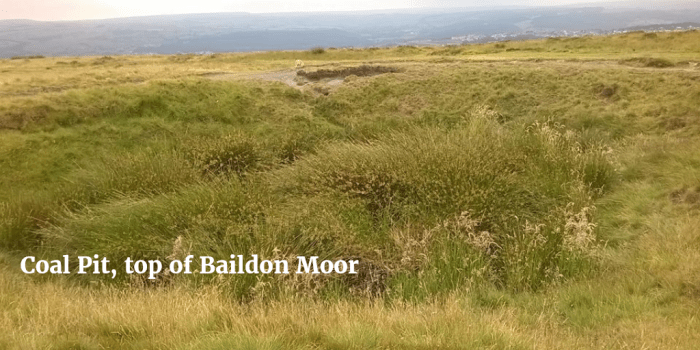
The element up here is an alchemy of gloss-faceted carbon mixed with sand- and limestone sedimentaries and shale. In some places the coal could be mined just under the surface skin of the Moor – its black dermis – easy pickings for colliers but low-grade at the top; the quality stuff harder got at and lower down in the dense, adamantine clutches of the ground. A messy craft of shaft and shovel to draw the deep, eighteen-inch-thick black treasure out. Now, if you scud a boot across the thin-grassed hillocks up on the crag, near the old pits left like belly-craters to fill up with rain, you uncover still a jet, dusty shale. Shards lie in smudges of smashed and broken pieces that hardly resist the boot, littering the path in compressions of primordial trees squeezed with economy into dark mysterious seams through stretches of time. A gobbet of coal from up the moor-path is a surprise of lightness in my palm: fetched through three millennia to my small hand, attesting to lost topographies, an inky remainder of strange oversized ferns and giant forests that once covered this land in close, pre-coal darknesses. Here now – after oozes of swamp, harsh glaciation and vice-like pressures – only grasses dare to shuttle up from earth to sky. Now the terrain is bald, the once-buried swamp forests in their secret pressings are forced to light again through its peeling, friable skin. And I think: everything falls apart at the seams at last. Coal remainders – uncanny when thought of as archaeology – show the Moor has not forgotten its ages-old biography. Its history has been matter-of-facted into place names and topography with Lode Pit Lane and Colepit Close.

A map of the Baildon Moor ‘Inclosures’ made by Robert Saxton in 1610, shows the craters of four surface coal pits like navels in the landscape. The workings were open; but later day-holes were dug into the sides of the hill for miners to disappear into like moles; bell-pits sunk down to seams and opened out at the top to collect up their black. These are now grassed over and boggy at bottom; the putters and huryers who worked and umbilicalled them more than a century since, dead, perhaps forgotten. In the 1852 Ordnance Survey map, several of the pits were already marked as old and out of use. Extensions to local railways and problems with floods would eventually close the remaining three mines worked by William Midgley after the 1870s. A census in 1881 shows only 3 men left working the pits, like fossils themselves, stuck in a monotony of work, scratching a living out of a land where the quality coal had already gone. Nothing left but the bits and pieces that I see today – carbon drawing on to dust – fit for home fires only. Now not even the tenements and settlements of the peripatetic coal workers remain at Low Hill or Moorside: in the end as transitory and finite as the black stuffs they excavated, no sooner uncovered than gone and moved on to the next seam of inky black sheen.

© Bradford Antiquarian Society: 1610 map by Robert Saxton of the Baildon Enclosures.

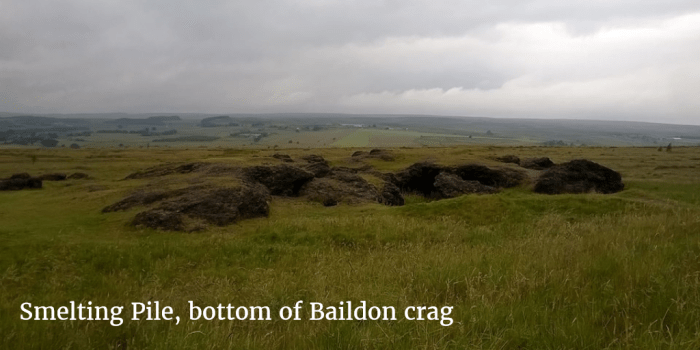
We make for the trig point on the topmost plateau of the hill to claim the lie of the land with satisfaction in our eyes, lungs, and feet braced wide apart against the wind. Cross-hatchings of putters paths, flecked with coal, go down from here near the old pits. Shards of the erst-landscapes lie at my feet like jumbled words that perhaps made sense all in a line down there in the stratified dark: a reflective gloss in the light of a lantern. A wilderness is available to us in 360 degree vistas and we see the enormous pock-marked leavings of nineteenth-century smeltings along the Dobrudden access road as though a volcano had extruded them in sulphurous loads. They lie quietly now in large cankers of surface slag, partly cladded over with grass and moss. The birds have marked this territory as theirs now: the meadow pipits, skylarks and plovers in numbers as the strong, vital sound attests. All heard but hardly seen. On the way back down I collect a banded curlew quill discarded in a tussock and put it carefully away to take home in my pack.

Smelting_Heap_Baildon_moor

The coal ways of Baildon Moor have become something other than they were originally carved out for. As early as the 1890s, day-trippers from Bradford – weekenders getting away from the cloying monotony of Victorian inner city smog with advice from zealous doctors; golfers anticipating the tee; butterfly collectors crazed with their nets; tweeded twitchers – all swarmed the Moor and overran the villages in pillages of the middle class at play. In 1910 the Shipley Times declared, “The country is tempting just now.” But industry itself was once powered from here: the traction engines, steam machines, the factory wheels, the tall valley chimneys issuing their smuts; these all got their spark from deep in the heart of the Moor.


With thanks to Joyce W. Percy whose article, ‘The Lost Villages of Baildon Moor’ was very informative, published online on the Bradford Historical & Antiquarian Society’s website.

Lines made while walking

Bramble mobbed and sure-shod I clamber up the glen on a soft camber of path under trees that shout in the merest breeze; and a slick of stream – more a dribble really, last loosenings of rain – partners me as I climb next to the tram line. Running off from the hill up top and making its asides, sometimes shrill but now a silver jumble of stone-jostled sounds. The water-tumble is joined by a sharp, distinct line of birdsong; no choice: bright day, sun out in everyone’s faces and the birds are loud in all places. Summer rejoices, everything exceeds itself, getting bigger and bigger with vitality of sap. A wren sends a voice out into the world larger than its own thimbleful of body.
How does it do that?
I walk under beech and oak, beside birches broken in anonymous storms before – perhaps – anyone thought to give storms names. I touch their cracked, lichenous skins and get in close to them, running a finger into their lines to find the paths far smaller things than I make their ways to and fro in. The trees overspread themselves and together enmesh the eye that would see through them.
Lines over lines over lines.
I walk the glen edges as if I’d know my limits, drawing my own line by Baildon Moor, up around the crags irresistibly down-looking into a dark crease of valley where the river can be heard as a whisper of something far greater hidden under dulled green canopies of trees. The crags are hard on the knees, up-reared and sheer, opening here into a crevasse, there onto a platform. Further on they perform the way itself; stretching out as bridges where the sandy silt of this sandstone grit which overlays the clay’s been washed away in – perhaps – those same nameless storms.
Take a lungful of air deep and try to preserve it as long as I can; become a bellows, and air and spore, sap-breath and moor-dust travelling through me. Eyes close to the view and turn inward to the view there. Spare.
And for the first seconds when I open them again, only blue as through a filter.
This is common land that endures for common folk to walk, to own, to share, and make lines across. Up by the woods-deep tramway; up Prod Lane; until the world opens out on top of me: sky blue, scudded with vapour lines and falling away limitless above. Rocks belowfoot become quarries and precipices at sheer horizon lines, leaving signs of violence; a landscape aggressively made to fit around and between.
I have seen rocks not as infinite in their roundness, nor as inviting of touch. My hands drag across them, invisibly marking lines on them as I try to decipher the marks other hands have carved on, not through, them.
Even these are not indelible to the rain.
Then through the grasses between as I go from monolith to monolith of rock – my steps older than Jurassic up here – carboniferous grit works itself into the grooves of my boots; the sleeves of my smock. And I pick a stalk for something to hold onto: its papery gold crackling in my palm as I squeeze the seeds of this almost cropped barley top.
Feet other than mine have made deep, dry-banked line-trenches on this rock-buttressed upland; walking a resolute yes to the rights of common ways: dog-walkers, runners, school-returning kids, lovers – these have all helped to lay down the lines of the glen.
Their sunken hollows – light lines between grasses and boulders – forcing and shaping the landscape around them, give the illusion of permanence.
May these lines never fade and may feet always walk-read them.

A walk into wet

I have been two days inside like Jeremy Fisher at the back door watching the pelting rain come down in slaps onto the mossy tarmac of my back yard. Throughout this plashing, there’s been a magpie haunting the eaves and chimney of the house with an ungodly squawking. I would say it is the rain has made it drowned-feathered and cross, but the magpie twitters even in the tentative truces between the rains. I wonder if it has a nest nearby it’s worrying over. Then, superstitiously, I think on a heartbeat, one for sorrow. Perhaps it is old Maggie – or my superstition – impels me to venture out today in spite of the weather. There is an uneasiness and all-thumbsiness to my preparations as though the spirit were willing but the flesh… I secure myself inside my rain coat (an improbable yellow) and shore up the feet in wellies, determined that the rain is not going to get a foothold. I will bring brightness with me today, I think with a touch of hubris, amidst all this dulled grey.

My rain coat is waxed so that the hood, when up, is like the skin of a drum and magnifies all noise in a little bubble about my head. This is a risky business near cycle lanes and traffic but, like an owl, I will be swivel-headed watching for anything coming. The thick drops dive-bomb me as soon as I close my front door, smacking the drum, and I body forth in hunkering strides with a grim and wholly sham defiance. Beat, beat, beat. Puddle-wonderful comes to me out of nowhere, an echo of E.E. Cummings. Humph! I make my position clear in my hunched shoulders like hardened soldiers: I am here under sufferance and because the magpie is a loud complainer.

The wind has worked itself up overnight from the west and the first part of my walk faces it head on. It shoves at me with unfriendly imperatives: be on your way! So that I have to tuck myself into it as it whips the air out of my lungs. Langstrothdale was the last place I walked in wind such as this, except that was in January in freezing weather and my brain didn’t even work then, just seized in icy surrender. Even the teeth feel that biting a cold. I should be grateful today then, but there is breath-stealing effort in this kind of walking and I find it hard to concentrate on much at first save putting one foot in front of the other; in front of the weather, as it strips through the glen. Nature’s joys are a little harder sought on a day like this; a turning day – a between-the-acts day – a spring-cleaning day when the season spills and washes itself,* tramps down and glosses its spent early signals underfoot. Sluicing everything to shiny newness. The wind beats the bounds and flushes out anything weak, spent, dead or dying. As I press on, the wild garlic is a yellowing untidiness about me, the rain releasing the last little ghost of its flavour. And in spite of my efforts I am soon washed too, ruddy and glow-faced with draggled ends of sleeves; glasses made prisms hard to see out of. Myopic mole. I tell myself that this wind, cold off the Atlantic, is a hopeful harbinger that carries the first promise of summer in its blasting breath. Hmmm. It’s a while before the buoyancy in this kind of thinking takes.

Still, I look for the seeds on everything: little universes waiting to burst their lives next year in quiet splendour. They do not mind if no one is watching; don’t mind bending a little under rain; just doing what they’ve always done. Grasses like weather-vanes beside the way bow beneath the wracking winds, frantically pressed together in creaking conference. They remind me of that bit in Vaughan Williams’s Greensleeves when the violins chase each other through grassy meadows. Or so it seems to me. Spring is turning into something else before my eyes. There’s been a curtain call and I wonder if I’m meant to see this bit. On the nap of the wind is a forethought of summer, soon here to throw up new things amidst the detritus which is already turning back into the ground. Buttercups – cups o’ joy I call them – bridge the gap and are grown top-lofty and scraggly in the meadows. They’ve got some ambition in them to grow so high, but the rain teaches them a humble lesson.

Early_June_Walk_JarofMemories(Kylie_Norman)

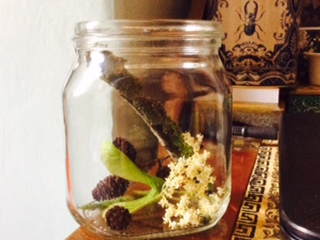
(Some titbits I collected from the path on my walk)

I am all out of kilter today, at odds without knowing why, and I feel petty and churlish as I pass by dervishes of buffeted elderflowers, saucers of cream balanced against the wind. To stick a nose into one is to try to catch its secret, except that you can’t. No attempt at enfleurage could recreate just that smell of rain-washed freshness. Underfoot lie the wind’s casualties: sycamore wings, oak apples, confetti of blossom. Tiny pine cones snap and groan against the boot. All this banquet brings the birds out into the path with tilted heads as if to say, perhaps a caterpillar or other juicy morsel has fallen. Blackbird, crow – a sparrow no bigger than a fistful of feathers. And on the playing fields beside the river, sharp-tipped swallows broadcasting and scooping the air as if they would catch the rain in big-bellied nets. A mesmerising layering of flights against the heavy grey. These are not bothered by weathers. Driving forward into the wind, I am almost oblivious to snail matings down on the ground: the two here are busy about their business, fuse-clamped together (again in spite of the weather).

Why, then, do I contend today with the weather? Ornery and morose. The willow wands in the water let loose their streams of leaves – why don’t I, like them, let myself be borne on? The rain has coursed the path with sand-flushed rivulets until it becomes a flowing tributary beside the river. Sucking my boots under. It’s true what some people say, that the path has muscles of its own; it’s honing them on me as I try to keep some kind of firm ground under me. I am planted into the path at intervals only to have to labour out of puddles dishonest about their depths. Yes, walking is striving today.

Still there is a pleasure in being out under this heavy soak. Mouth full of the smell of soil and soft mulch under trees; leaves waxed in watery deep greens, reflective as glass. Clover, and something other I don’t have a name for, have crept out beside the bank. I don’t know many names for the flora and fauna I see and I walk onwards groping at the kinds of names they might be. Pink gossiper, lifted lips, gossamer glory. Fancies. Beside them, the water takes the image of the rain like a negative, reacting in bubbled dips to its pelting, throwing out rounds of ripples. I wonder what it sounds like to a fish? Is that a stupid question? It seems to move in harder and harsher clouds for a while and I am bent-backed with it – surrendered at last. And on the bank a wagtail is sitting, like its name, in perpetual motion, just watching out of a little dark eye.

Loosening a little, the wind lightens on my return and the rain shakes off some of its emphasis. Now just chatter in the background, the kind you encounter from an unexpected acquaintance at the supermarket, slowly but surely settling into their patter. I mind it less now, this hum-drum clatter, my feet slurping into puddles I had groused at on setting out, stirring up the silty bottoms of them with a – perhaps – gleefulness. Now I make my peace. Palms outward to Old Mother Goose, hissing her sharp-tongued warning at me in protection of her littl’uns; I’ve heard all your bluster before, mother, I won’t harm you. And, wetly, I turn back up the hill.

I arrive home sodden, fresh-faced, buoyed and better for having had the breath knocked out of me. And for having been distilled a little in elder blossom.


*I have, with a little licence as to season, used an image from Tolkien’s Fellowship of the Ring here, taken from Tom Bombadil’s explanation to the hobbits after a wet day in the Old Forest, “This is Goldberry’s washing day…and her autumn cleaning.”

Looking for stag beetles I found instead…

Shipley glen is shrouded in mist as I make my start, for last night’s rains are already burning off under a sun beating to get through the lingering cloud. It could go either way, I think, but cavalierly shuck the idea of a rain coat like a too-cautious skin. Anyway, I’m aiming for cover: for nature’s putting-away and hiding place, the woods. The leaves will umbrella me if needed. I am all eyes down, for I have about me an express purpose today: today I will search out the liquorice-lacquered stag beetle – Scarabaeoidea – and like a child I of course hope to find the male of the species with its cumbersome and fearsome looking antlers. Pincers I’d always thought them; nippers; doers of harm and my soft brain had counselled caution. Not to go near, not to like, not to find it beautiful to carry your weapon of defence so outward and obvious. All its perfections on its head. Once, I had seen one outside my first remembered home traffic with a spider. And lose. It was dragged down a sewer cover in the end to an undisclosed but entirely known fate. I must have been little for all my memory is very close to the ground of that little battle.

No remarker of hawthorn blossom today I – and just as well for it’s nearly all over now; no noticer of the almost-adult goslings on their glides. The canal a brown be-petaled stillness beside me. Too open to the sky and moving feet, bike tyre and push-chair wheel here. But still I am studious at the sides of the path looking for its jet-black armour. It’s a kind of discipline, to hold the image in the mind’s eye – a glint of black making ponderous passage through last year’s leaves – and hope that by omnipotence of thought you’ll somehow conjure it to shuffling life. Any black thing is a tantalising promise for just a second until the eye discovers it as something else. More often than not the intrusions are dog litter, careless cast-offs by the way. There’s a claustrophobia in looking down into undergrowth so long and I want to turn up the face, stretch the back, and see the birds who are trilling their songs, but as I said this is a discipline and just my luck if I looked up and lost the sight of this click-carapaced wanderer. It’s a slow kind of walking that’s required in swervy zigs and zags. Were I a snail, I’d have limed the path in silver traces back and forth by now. But I don’t really expect him to show himself here: I’m waiting on Hirst Wood for my prize viewing.

There’s a close relief as I get under the canopy of the first few trees and breathe deep the mulchy, pulpy air. It’s thick and heavy under here: humid invisible presences like walls you walk through under the densest of the trees. The wood trying to air itself after the rain. And I should have thought about the mud as my impractical shoes sink and grapple. I tussle with a problem here which I had not thought to have – there is leaf mould in every direction of course so where best to look for the bashful beetles? There’s a loggery up ahead. That might yield something. But I look into all nature’s hidey-holes along the way, just in case, for these are the refuges I know will keep them: close, pent, safe for a secret mating. Into bored out tree trunks – made shells of their former selves by wood worm; under logs wet with last night’s rain. And all the while a chorus of loud dripping going on about me as the leaves shed the last drops of wet in heavy globes. At the stands of nettles and brambles I am defeated – beware all ye who enter here. A spiteful thought: that will of course be where they are hiding.

At the loggery I turn up the usual suspects under the smallest logs: woodlice almost made primordial in their see-through armour that the dark has not trained to colour; some worms wriggle about; and no doubt smaller things than I can see. I stand up and still disappointment takes me for a moment – and then in the periphery of my eye, a rustle of leaves. I look down in almost-welling hope and there’s a flash of grey-brown soft down. No stag beetle but something else. Tiny, delicate, pointy-nosed little fidgeter dives out from under the log to pull at leaves. Like a mouse, but not. The name won’t come, but I’m struck by an almost-recognition on the tip of the memory – something moley, casting me back to a Wind in the Willows or Farthing Wood childhood parody. That sooty brown coat, that whiskered sharp nose, the hiding eyes. Two of them now! I am so still beside the fallen tree limbs and other ‘whack’ that they’re safe enough to venture a sniff from out beneath the log and tease leaves back under with them. One look is to imagine one in my palm: its lightness, its smooth fur, the tiny bones, absorbing all the world – food, mate, danger – through its uplifted tapering snout.

It was, I later learned, a common shrew: sorex araneus. A whole realm of signification haunts this innocent snuffler. Wayward women we are told need taming: wives who berate, scold and prate at husbands worn down into the ground by it. How did you, little burrower, get weighed down by all this angst? Is it the pointy nose that struck a chord? Looking as though it would be in at everyone’s business: poking, prodding; nagging, attacking. But all I see is a dainty little rummager. Furtive flashes from the safety of the logs into the cool leaf mould show you to be indifferent to human mythologies. I stand and observe you in petrified stillness for a while lest I disturb. Then – nothing. You’ve hunkered down in your lair, I assume, but I still linger as if my reverent quiet will bring you out again. But no, no more. Don’t be greedy.

‘Beshrew me’ uttered in the antique sense was to call a curse down on oneself. But I felt the opposite on this day where I went out to see stag beetles and instead caught darting glimpses of shrews. Like so many of life’s adventures, misbegun; but in the slick-treed wood, errant hope got this exchange.

Welcoming in a Spring

The day would be good for walking I decide and once decided it becomes – for me at least – a single pressing thought, almost as though it had a life of its own: like a spell or an almost child tugging on your arm and dragging you towards the front door. Itchy soles of feet; palms waiting to clutch at the outdoors air; heart full as an egg to see all nature’s sudden surprises. When this mood is upon me, I am restless to anything else and the walk needles itself into my consciousness with the insistent question when, when, when? Nothing worse than to ignore the call; depression and doldrums the penalty. When walk calls, the feet must fall in. I am learning it is something to protect from the tyrannies of household chores and work. I curate my walks now: make a little space for one every week, bottle them up like scent, and stow the little treasures away to sometimes take out, carefully handle and fix in the memory.

Today the sun has got itself up pretty well into the bluest of skies and there’s a warm thickness to the air that promises dry ground underfoot and a slow sluggish canal or river to walk by. I am elated stepping out of my front door, padding along the neat little same-and-yet-not-same Saltaire streets, with a fondness for everyone whom I pass because we are all complicit in this wonderful warm May day together – in the determination to be out of doors and to soak sun into skin. And yet I do not know exactly which path I will take – canal to Hirst Wood, the Nook Lane to Nowhere, or the river path? I let my booted feet decide as they trip along by the canal, wafting and wefting and warping the path’s dust about me like a chalky cover-all. I know each path a little more with each week – the goodies to look out for: the hawthorn in prickly blossom; the fluff-feathered goslings; the sweeps of bluebells. All lie before me, known stops along the way, and my feet go with the slow haste of anticipated joy and savouring delay.

I retrace a bit – why not? The stone squeeze by the canal where you go down to the river path almost makes it seem a secret. You slip off into it as if the very first to make this delicious discovery. The stones lip my boots as I go, jostle my steps as they pebble the path, and over all the thrushes, blackbirds and crows fly and dip their shrewd wings like greetings. Thin nasal siren of a bee alarms for just a moment as it brushes past and is quickly gone upstream. Over the bridge, over the river, a flicker of dapple tricks down through the branches from the sky and dances over the path to web the way with white. This – as I expand my lungs to take in the arid, laden air – this! is nature’s way to welcome in a spring.

Round the corner and out of nowhere the downy globes of dandelion heads emerge to bob and nod – a clutch of waiting wishes to bless you on your way. The ground dips down and rushes me on till, level with the river, feet plant into grassy banks to muse at the overgrown round tower of the derelicted bridge. Through the field brighter than the brightest green quilt, I come to its edge and seam where bees are at work shuttling in and out of one another’s way in a strange furious dance and play. A gurgle of stream is crossed, its rocky bed water-slaked and mossed. Down by the boat club where swallows dip and follow, another stream. Temptation to bathe hot swollen feet, but I retreat with the coward thought, someone might appear!

Whoever knows what makes us look up to see the secret thing so many others miss? Today’s was this: a heron across the way, stealthy silent stalker in the river’s languid pull; strange snaking neck and big gawky wings. All the herons I have never seen were because I was not watching, but now my attentiveness connives to bring you to life, careful flutterer, weaving in between the weeds. I wonder about your steady step as you reveal your grey again. This is a slow dance to draw a minnow out. I would not disturb your subtlety for all the world. Sudden as an arrow or the end of a song, you’re gone. The mallards with their young are busy on their glides and do not mind the dark tickle of baby minnows under-web whose embryonic selves, flickering almost by accident with the current, gather in dense translucencies: something the river keeps but cannot hold for long. A robin a flash of red song on a lichen-laced branch, no sooner spied than it flies.

I clamber up the ridge under a parasol of sun-blasted green and the tree branches dip low in spite of me. Whitened and jewel-like in the sun, clouds of flies startle as I push on – you see them hanging over the river; great shifting billows preside there and trap the light. Sharp shaft of wild garlic up the nose calls the gaze downward to a maze of white constellated stars. Beside me I pass trees sleeved with ivy until they are covered with it: trefoil leaves close as clothes. The bluebells up the bank – straight purple blazons – sing out their short lives as they renew and rejuvenate the woods. And I burst with it too – my whole being alive with this becoming, this husk-splitting on-rush of life.

At last I am but a willing receptacle for precious impressions: a pigeon as heavy and cumbersome in flight as its image to get down. The lace of the cow-parsley heads – finer than a bride’s veil – looking sugar-spun and gorgeous to taste. A duck landing mid-river with a skirmish of feathers. Smooth and silky in the sun, iridescency of mallard’s crown. And as my steps turn homeward, its rasp-throated call.