Blog

Walking with my Father

My father’s strides are twice the strides of mine;
bee-blinded and spore-gathered, I drag the path behind,
lingering by the dry stone wall a time
to see lapwings, fluff-fringed, give chase with their cries.
He makes space for my whimsies, as though delay
at vetchlings and foxgloves and other outdoor loves
were not a pain and he’d not rather be going
to lay the path ahead, to seek a stile,
and leave the tussocks, bogs and ditch behind.
The way is long, he’s things to do, but this too is true:
he lets me amble slow to know a place,
while striding on and covering twice the space.

Patiently, he waits my searches out,
calling advice on where to step and not.
In spite of warnings I am mud-slicked, got
with grasses, seed-muddled, moth-tickled, hot.
He keeps a gracious silence on my dirt;
he’s seen me bramble bruised and hurt
in childhood trees at childhood games when young,
knee-high to a sapling, unformed, unbegun
to life and death and future happenings.
His hands have swung me high up into trees;
and round in circles. Now, older, his hand’s squeeze,
in the fields’ up-and-overs, says ‘if you need.’

Together but separate, like moon and planet,
each walking our own particular gait. Always though,
when got ahead, he waits with half a knowing smile,
drawing a bead on the horizon mile until,
fresh with meadow daisies, speedwell, sorrel,
and weathered with smiles of green dreams –
of black moths and bullocks one week new,
and full of my discoveries and spring-caught cheer,
I at last appear; never so slow that he’d leave me behind,
even if he’s fly-swarmed and over-sun-warmed waiting.
My father strides with steps twice-large as mine,
along the path that I’ll eventually find.

Of Flowers, Wildernesses and Hauntings

The sounds of puttering families background the first part of my walk today, like a stereo left on – white noise in the street mingling with the birdsong – because it’s the weekend and we are all thumbing our noses at the unpromising sky. It is that species of spring in-between weather when some people throw caution away, donning shorts and short-sleeved tops, and others pass like admonitory puritans in full rain-gear as if to say, these clouds won’t clear. I am somewhere in between, a half-optimist, a hedge-my-bets-ist, with a cardigan and jeans rolled half-way up and pumps on my feet. I disdained an umbrella and a watch on setting out, a decision I’ll probably regret, even if it was made in the spirit of freedom from constraint. Largely oblivious to the surrounding sounds of humanity beside, behind and in front of me, I have my nose folded into a book on wild flowers, resolving to find them all out in their haunts, until a fretful child complains loudly at a sudden shower and a beleaguered father, weariness in his step, consoles with the magic words we will go home. Not I. The rain invokes the latent metallic tang of the soil from the ground and I am overtaken by a pall of warm, wet, mineral mist. This may be as good as it gets today and I am eager to collapse into it.

The search for wild flowers, taken at face value, sounds romantic and a little frivolous; a remnant of a very Victorian manufactured chivalry, or that dreamed up in the musical Camelot when Arthur earnestly explains the legitimacy of flower-gathering to Lancelot, as though checking through some form of ‘Chivalry Calendar’ where it is written next to May/June, in large gothic typeface, disport thyself with finding wild flowers and garland thy lady therewith. I am for looking, not picking today. The right to gather flowers was one of many time-out-of-mind rights hotly contested in the late Victorian period between the rural working classes and landowners. Enclosure of much formerly common land made the picking of flowers, from which a whole folklore including country songs, herb lore and courtship rituals stemmed, a tradition soon to be lost. Since then I wonder how many of us really see wildflowers: the bit of wild on our doorsteps. Too many are prosaically classed as mere weeds, their former uses forgotten. I am come today to see how my native patch is enlivened by wildflowers; as I say, not to pick, for I prefer my wildness left where it is, though my intentions are indeed acquisitive. I mean to put names to them, to assemble each different one into an imaginary bouquet, collect them up, and write them onto the page; to better learn them so as to know them when I see them again. I am determined to become a noticer of all nature’s ‘nothings’, and to build a deeper connection through noticing. After all, a flower’s honest intention and design is to be noticed, simply in order for pollination to take place. And if, as Marvell claimed, the ‘industrious bee computes his time as well as we’, then perhaps I might just as well spend a little of my time over flowers.

Casting myself adrift, then, into the flower banks of Shipley glen, between the canal and the river, I am in no great hurry, and I look – really look – at every flower, like a pollen-stockinged bee myself, deciding where to land a glance, stick my nose, or linger. I am delighted and thrill-drunk when I match them to their names. To confer names is a serious business, an act of creation, as Brian Friel understood when he wrote, “We name a thing and – bang! – it leaps into existence.” There are the flowers I already have names for – yellow water iris, poppy, forget-me-not, cow-parsley – but then there are the new discoveries along the way: tiny, bright yellow purses of the kidney vetch by the side of the water, the true blue of the crane’s bill, clovers in two colours. So engrossed in my examinations am I that I startle three mallards sheltering under the bank who skitter and flank together with a splash as I return guiltily to the safety of the path. Even the outrage of mallards cannot stop me from continuing my searches however. Flourishing on an overgrown soil heap, there’s the wild pink geranium, herb-robert, that some call storksbill because its forming bud is beaky. Its flowers are unshowy and unfussed by my regard: tiny-veined, five-petaled faces lift up lively to the sky; its stems flushed red under the sun. It was believed once to be a good luck charm and a fertility herb. Hopeful country wives had it tucked under their pillows, their heads laying down wishes on top of it. Now that we’ve been formally introduced, I begin to see it cropping up everywhere, a sort of guide to my walk today, as though vouchsafing my passage.

Well into the thick of the meadow are the brute stems of the hogweed, supporting flower heads as big as dinner plates, swaying heavily, and looking like they’ll bend or break in the breeze. I clamber ungainly into their midst in tick-fearing perhapses of footsteps as if at every step a nettle might hold me to ransom over a sting. I will NOT be stung, the soles of my feet insist quietly, caution in their presses. Nettles too have their flowers though: little woolly skeins of green. And though irksome to us, 40 different varieties of insect, winged and carapaced, depend on this prickly pest plant, including the red admiral butterfly, and a host of moths. A scattering of heart-shaped leaves is prevalent under the hogweed: black bindweed that some call buckwheat is leading a merry dance and you have to look hard to see where it has snaked the stems of other plants. Some call it devil’s tether, swaddling itself and other plants tight together. A closer look confirms it has made a pact with the nettle; it is growing up its stems, neatly corkscrewing them in black, and proffers its counterfeiting leaves so I maybe won’t see the stinging set beneath. How clever of them to fall in together at such a trick. Just in case of mishap, I find a patch of dock leaves close by for a swift remedy. Nature is astute like this.
pablo(15)

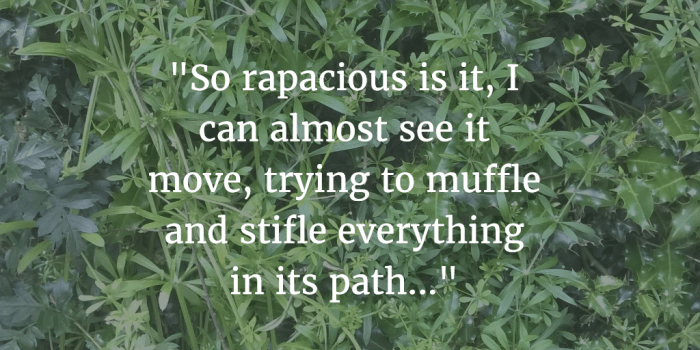
The next flower-bearer I almost miss, as it so eagerly blends into the general green – this suits its purpose, you see. Sticky goosegrass – or cleavers, catchweed, stickeljack or grip grass (apt-sounding names) – barbs my hands and arms as I take hold of it to find its white pin-prick flowers. I was careful of the nettle, for I knew the risks, but no one ever told me of the rash goosegrass can give. Red itch blooms over my arms and (somehow) my neck and I am defeated in spite of myself, splotchy and needled by heat. A lesson learned. The goosegrass has swallowed the low-lying branches of an ash and is making quick work of the willowherb underfoot, sticking to it tenaciously by virtue of its tiny hooks under leaf and along stem. Its flowers are, according to my book, ‘rather insignificant’ and no bigger than a dot; but it’s as well not to dismiss this busy worker. So rapacious is it, I can almost see it move, trying to muffle and stifle everything in its path like a super-animated cobweb that needs no spider to direct it. It is the swiftest and most adamant at reclaiming land for nature; butting in and talking over its neighbours, running as fast as its prattle will take it. No wonder its flowers are so small; all that energy goes into throwing out streamers, which feel along other plants like scouts going ahead into battle, the forerunners on a quest to colonise more and more green. The thing that all these plants have in common is that they are most often to be found in waste places or places whose cultivation has been suspended. Humanity moves out and these plants move in as speedily as they can, bringing a bit of wildness to suburban fringes.

I sit down by a gurgling swell of the stream – an Aire river tributary – to eat my lunch of bread and cheese and cherries and to let my bare toes burrow into grass and sandy soil, needing the contact with the earth. My bottom is quickly wet from the earlier shower but I don’t mind as, with illicit pleasure, I cast my cherry stones into the stream to be taken where the water wills. A pitter patter of rain starts up again, steadily getting heavier, so I remove myself to the cover of a sycamore, generous-leaved and obliging, still listening to the water running over stones in hollow-sounding plunks. Coming from farther away, I can hear the disturbance of the weir like a knife upsetting the river, giving it drama and something to complain over. Then a child splashing about happily with his father, singing, ‘rain, rain, go away, come again another day.’ My lips curve in a sickle moon of delight.

When the rain slackens off and the sun shows itself, I take the little road by the boat club with no clear idea of where I am headed, only knowing that I have exhausted the flower-spotting down by the river and wondering what the side of the valley might reveal. The road leads to a gate and then a wide avenue, which is sun-speckled, warming, fly-moted and rich with the smell of cows from the adjacent field. Manure and hairy hides baking in the emergent sun all mingle together and I breathe deep. This is a Thomas Hardy smell and my mind hooks onto images of hot, milky summers in lowland pastures. Brow pressed against a warm cow side as milk fizzes into a bucket. A blackbird capers madly across the road at my coming looking a little chastened and indignant (and, it must be said, a little silly) at being disturbed. Couples of them begin to sing to one another from the horse chestnut trees, ending in high-noted questions that never seem to get answered, going round and round in endless enquiry. I am jealous of them: jealous that I did not find this avenue in the early spring when the trees had their spires of scented blossoms, all running in a perfumed line. I hug the field boundary here and, warily now, spot the goosegrass again, this time enacting one of its other names, robin-run-the-hedge, as it makes quick work of enveloping the holly margin, covering it up in its sticky stems like a lover that won’t let go.
pablo(13)

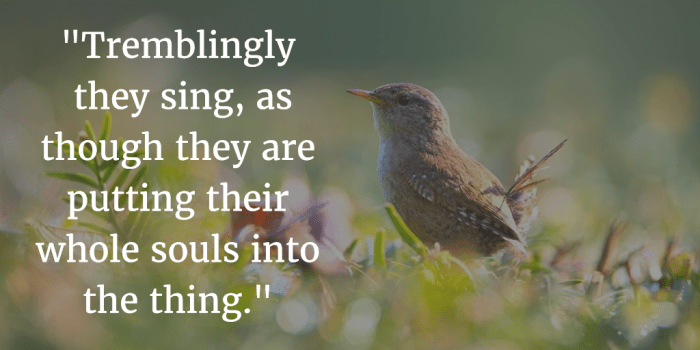
The sun is tucking and untucking itself in the clouds and can’t seem to make up its mind whether to partner me the rest of the way. Its aloofness pricks my determination to enjoy myself as I pick my path over stone, pressed through long use into the clods, and pause by a hawthorn tree. I hear a start in the ivied roots here and wonder. A vole? Mouse? Stoat? Rabbit? But none of these appear. A pair of tiny wrens suddenly emerge, each no bigger than a thumb, nut-brown and spotted, very dear. Miniature delights. In birders’ terms they weigh no more than a pound coin, but I would not put so low a price on them. Tremblingly they sing as though they are putting their whole souls into the thing and I stop to listen, and watch them bob their tails. The field where the cows are grazing seems hazed and full of possibility as I look out over it and I take in a glad breath as the path starts to build ground. Further on, a squirrel and I surprise each other equally and hold each other’s gazes, mine looking into its eye glittering darkly from where it sits frozen on top of the wall. It is a strange feeling, knowing that for this instant its whole little being is fixed entirely on me and mine on it. There is a little stand-off, but the squirrel is the first to break contact and back-track disappearing who knows where. It is uphill work and tiring, come on legs, and I keep looking ahead to gauge the distance still to go until I reach my summit and the limit of the path.

I do not expect what I find next – a full-stop at the top of this little lane. A gate – but so curious a gate – leading on into Fairbank Wood, a patch of woodland awkwardly situated between boundary walls of various kinds, each jutting out at degrees to clasp and hold the wood between them. This gate looks more fitted to being in one of the royal parks in London than bracketing the way to a scrap of woodland off a farm lane. As strange as Lucy coming upon the lamppost in Narnia, I think to myself. And, with six golden orbs at the heads of the iron posts, it is grandiose and out of place: a relic from something else, and here my mind catches at a truth as it turns out. I later learn this all used to be part of the Milner Field Estate at the heart of which, at the heart of the wood, was a gothic-steepled great-house owned by the son of Titus Salt, mill owner and founder of Saltaire. It seems it was an unhappy house which, rumour has it, blighted those who lived there with strange and unusual deaths or persistent bad luck. Fortunes lost, sudden heart attacks, drowning, scandal, blood poisoning from a thorn scratch. Queer happenings, made the more uncanny by being focused in one place. Now I know a little of its history, I wonder if there is such a thing as genius loci: if a place really does have a spirit or a memory.

I pass through the gate onto what looks like an old carriage way with a central three-cobbled line snaking it like a back bone. And occasionally a row of stones cuts across the way to carry off flood water through little culverts spaced at intervals along the base of the dry stone wall. The astronomer Fred Hoyle, who coined the term ‘Big Bang’ to describe that primary cosmological shock, grew up near here in Gilstead during the First World War, in the lea of that sad house, and wrote of how he and the other village children used to squeeze themselves through these culverts to sneak onto the estate, only to be caught and have their hides tanned by gamekeepers. The woodland floor shows no signs of upkeep now, having given way to ground elder in advancing militias. Hollow-stemmed, deep-rooted, intractable – the devil in a garden. It’s another sort of wilderness here, but this time the kind that follows tacit abandonment. The house, apparently, could not be sold at auction – no one would buy it – and so was dynamite-blasted in the 1950s. Then demolition gangs were sent in to finish dismantling it, leaving the stone as a resource for mill repairs. This ‘undoing’ of the house speaks for itself, for it was very splendid in its hay day and entertained royalty twice. Now only rubble remains. The woodland has completely taken it back: the goosegrass, bindweed and elder all smothering the persisting stones into silence. It has returned to nature and, my superstitious thought supplies, perhaps does not look kindly on interlopers. The mosaic floor of the conservatory is still discoverable in the middle of the wood, and lying under the fast-growing trees are the old cellars, ivied over and moss-grown. Little snatches of herb-robert grow in the cracks of the old garden steps; or to give it its common name, death-come-quickly.

pablo(17)

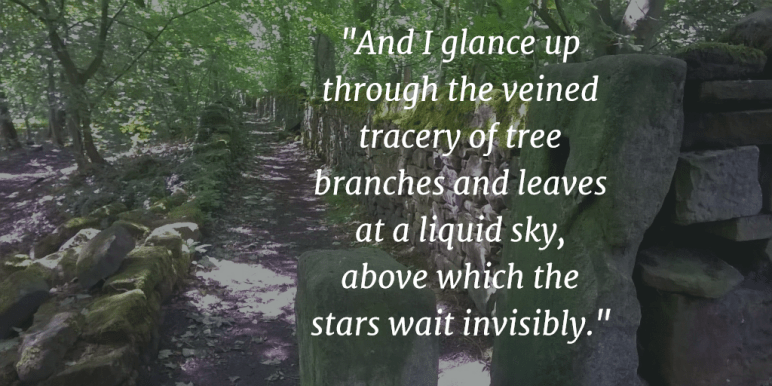
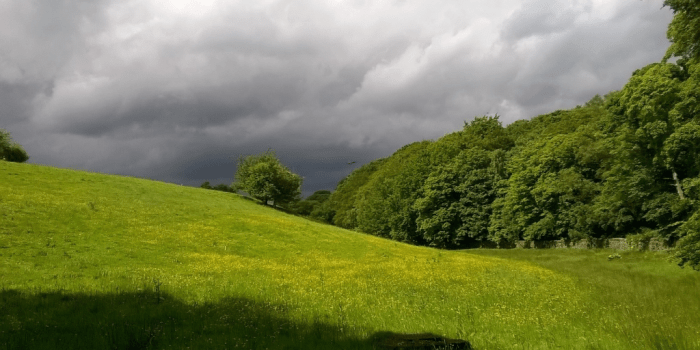
Sparable or Sparrow’s Bill Lane, wall-sided and tree-shaded, leads off on the left here – a public right of way, still tramped by walkers’ feet, the sign pointing the direction proving that it’s not forgotten. An old labourer’s path perhaps; a shortcut for the estate workers from whence they could hear the ringing of the mill’s shift bell; a trysting place for lovers after the Sunday service. To walk it is to walk into history, treading where so many other feet have trod before. Two Neolithic-looking stones guard its entrance, though in truth they can be no more than 200 years old: they keep the way. Walking it now, I am helping to keep it too, and in a split-second of kinship with other walkers, and other writers of walking, feeling the pound to ground as a great leveller of humanity, I smile and am eager to dive off into the lane to see where it might take me. Half an hour later, wearied, still rash-prickled and now a little fretful, I have been sucked down into twists and turns until I am disorientated and no longer know my bearings or the direction for home. The path draws me in a noose more tightly around the former estate and there is a closeness on it and a feeling of needing to get on that I don’t investigate too carefully. The tree cover breaks at last and it’s like coming up for air, a brief caesura in the chug of mud and close-cropped ivy and stumbling stones. This is where Fred Hoyle used to take himself off for his gambols to spot birds’ nests; where, at the age of seven, he overcame his fear of the dark by making himself walk this track at dead of night as others had done before him. One of the most renowned astronomers in the history of the discipline, he perhaps first sighted the stars from a clearing such as this, quaking a little at night terrors and sinister shadows, as I quake a little with having been turned about in the wood in the broadness of day. And I glance up through the veined tracery of tree branches and leaves at a liquid sky, above which the stars wait invisibly.
pablo(14)

A walk into wet

I have been two days inside like Jeremy Fisher at the back door watching the pelting rain come down in slaps onto the mossy tarmac of my back yard. Throughout this plashing, there’s been a magpie haunting the eaves and chimney of the house with an ungodly squawking. I would say it is the rain has made it drowned-feathered and cross, but the magpie twitters even in the tentative truces between the rains. I wonder if it has a nest nearby it’s worrying over. Then, superstitiously, I think on a heartbeat, one for sorrow. Perhaps it is old Maggie – or my superstition – impels me to venture out today in spite of the weather. There is an uneasiness and all-thumbsiness to my preparations as though the spirit were willing but the flesh… I secure myself inside my rain coat (an improbable yellow) and shore up the feet in wellies, determined that the rain is not going to get a foothold. I will bring brightness with me today, I think with a touch of hubris, amidst all this dulled grey.

My rain coat is waxed so that the hood, when up, is like the skin of a drum and magnifies all noise in a little bubble about my head. This is a risky business near cycle lanes and traffic but, like an owl, I will be swivel-headed watching for anything coming. The thick drops dive-bomb me as soon as I close my front door, smacking the drum, and I body forth in hunkering strides with a grim and wholly sham defiance. Beat, beat, beat. Puddle-wonderful comes to me out of nowhere, an echo of E.E. Cummings. Humph! I make my position clear in my hunched shoulders like hardened soldiers: I am here under sufferance and because the magpie is a loud complainer.

The wind has worked itself up overnight from the west and the first part of my walk faces it head on. It shoves at me with unfriendly imperatives: be on your way! So that I have to tuck myself into it as it whips the air out of my lungs. Langstrothdale was the last place I walked in wind such as this, except that was in January in freezing weather and my brain didn’t even work then, just seized in icy surrender. Even the teeth feel that biting a cold. I should be grateful today then, but there is breath-stealing effort in this kind of walking and I find it hard to concentrate on much at first save putting one foot in front of the other; in front of the weather, as it strips through the glen. Nature’s joys are a little harder sought on a day like this; a turning day – a between-the-acts day – a spring-cleaning day when the season spills and washes itself,* tramps down and glosses its spent early signals underfoot. Sluicing everything to shiny newness. The wind beats the bounds and flushes out anything weak, spent, dead or dying. As I press on, the wild garlic is a yellowing untidiness about me, the rain releasing the last little ghost of its flavour. And in spite of my efforts I am soon washed too, ruddy and glow-faced with draggled ends of sleeves; glasses made prisms hard to see out of. Myopic mole. I tell myself that this wind, cold off the Atlantic, is a hopeful harbinger that carries the first promise of summer in its blasting breath. Hmmm. It’s a while before the buoyancy in this kind of thinking takes.

Still, I look for the seeds on everything: little universes waiting to burst their lives next year in quiet splendour. They do not mind if no one is watching; don’t mind bending a little under rain; just doing what they’ve always done. Grasses like weather-vanes beside the way bow beneath the wracking winds, frantically pressed together in creaking conference. They remind me of that bit in Vaughan Williams’s Greensleeves when the violins chase each other through grassy meadows. Or so it seems to me. Spring is turning into something else before my eyes. There’s been a curtain call and I wonder if I’m meant to see this bit. On the nap of the wind is a forethought of summer, soon here to throw up new things amidst the detritus which is already turning back into the ground. Buttercups – cups o’ joy I call them – bridge the gap and are grown top-lofty and scraggly in the meadows. They’ve got some ambition in them to grow so high, but the rain teaches them a humble lesson.

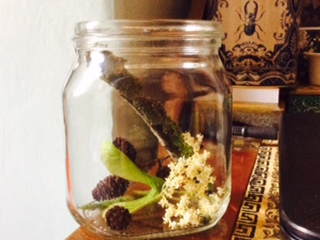
Early_June_Walk_JarofMemories(Kylie_Norman)

(Some titbits I collected from the path on my walk)

I am all out of kilter today, at odds without knowing why, and I feel petty and churlish as I pass by dervishes of buffeted elderflowers, saucers of cream balanced against the wind. To stick a nose into one is to try to catch its secret, except that you can’t. No attempt at enfleurage could recreate just that smell of rain-washed freshness. Underfoot lie the wind’s casualties: sycamore wings, oak apples, confetti of blossom. Tiny pine cones snap and groan against the boot. All this banquet brings the birds out into the path with tilted heads as if to say, perhaps a caterpillar or other juicy morsel has fallen. Blackbird, crow – a sparrow no bigger than a fistful of feathers. And on the playing fields beside the river, sharp-tipped swallows broadcasting and scooping the air as if they would catch the rain in big-bellied nets. A mesmerising layering of flights against the heavy grey. These are not bothered by weathers. Driving forward into the wind, I am almost oblivious to snail matings down on the ground: the two here are busy about their business, fuse-clamped together (again in spite of the weather).

Why, then, do I contend today with the weather? Ornery and morose. The willow wands in the water let loose their streams of leaves – why don’t I, like them, let myself be borne on? The rain has coursed the path with sand-flushed rivulets until it becomes a flowing tributary beside the river. Sucking my boots under. It’s true what some people say, that the path has muscles of its own; it’s honing them on me as I try to keep some kind of firm ground under me. I am planted into the path at intervals only to have to labour out of puddles dishonest about their depths. Yes, walking is striving today.

Still there is a pleasure in being out under this heavy soak. Mouth full of the smell of soil and soft mulch under trees; leaves waxed in watery deep greens, reflective as glass. Clover, and something other I don’t have a name for, have crept out beside the bank. I don’t know many names for the flora and fauna I see and I walk onwards groping at the kinds of names they might be. Pink gossiper, lifted lips, gossamer glory. Fancies. Beside them, the water takes the image of the rain like a negative, reacting in bubbled dips to its pelting, throwing out rounds of ripples. I wonder what it sounds like to a fish? Is that a stupid question? It seems to move in harder and harsher clouds for a while and I am bent-backed with it – surrendered at last. And on the bank a wagtail is sitting, like its name, in perpetual motion, just watching out of a little dark eye.

Loosening a little, the wind lightens on my return and the rain shakes off some of its emphasis. Now just chatter in the background, the kind you encounter from an unexpected acquaintance at the supermarket, slowly but surely settling into their patter. I mind it less now, this hum-drum clatter, my feet slurping into puddles I had groused at on setting out, stirring up the silty bottoms of them with a – perhaps – gleefulness. Now I make my peace. Palms outward to Old Mother Goose, hissing her sharp-tongued warning at me in protection of her littl’uns; I’ve heard all your bluster before, mother, I won’t harm you. And, wetly, I turn back up the hill.

I arrive home sodden, fresh-faced, buoyed and better for having had the breath knocked out of me. And for having been distilled a little in elder blossom.


*I have, with a little licence as to season, used an image from Tolkien’s Fellowship of the Ring here, taken from Tom Bombadil’s explanation to the hobbits after a wet day in the Old Forest, “This is Goldberry’s washing day…and her autumn cleaning.”

Looking for stag beetles I found instead…

Shipley glen is shrouded in mist as I make my start, for last night’s rains are already burning off under a sun beating to get through the lingering cloud. It could go either way, I think, but cavalierly shuck the idea of a rain coat like a too-cautious skin. Anyway, I’m aiming for cover: for nature’s putting-away and hiding place, the woods. The leaves will umbrella me if needed. I am all eyes down, for I have about me an express purpose today: today I will search out the liquorice-lacquered stag beetle – Scarabaeoidea – and like a child I of course hope to find the male of the species with its cumbersome and fearsome looking antlers. Pincers I’d always thought them; nippers; doers of harm and my soft brain had counselled caution. Not to go near, not to like, not to find it beautiful to carry your weapon of defence so outward and obvious. All its perfections on its head. Once, I had seen one outside my first remembered home traffic with a spider. And lose. It was dragged down a sewer cover in the end to an undisclosed but entirely known fate. I must have been little for all my memory is very close to the ground of that little battle.

No remarker of hawthorn blossom today I – and just as well for it’s nearly all over now; no noticer of the almost-adult goslings on their glides. The canal a brown be-petaled stillness beside me. Too open to the sky and moving feet, bike tyre and push-chair wheel here. But still I am studious at the sides of the path looking for its jet-black armour. It’s a kind of discipline, to hold the image in the mind’s eye – a glint of black making ponderous passage through last year’s leaves – and hope that by omnipotence of thought you’ll somehow conjure it to shuffling life. Any black thing is a tantalising promise for just a second until the eye discovers it as something else. More often than not the intrusions are dog litter, careless cast-offs by the way. There’s a claustrophobia in looking down into undergrowth so long and I want to turn up the face, stretch the back, and see the birds who are trilling their songs, but as I said this is a discipline and just my luck if I looked up and lost the sight of this click-carapaced wanderer. It’s a slow kind of walking that’s required in swervy zigs and zags. Were I a snail, I’d have limed the path in silver traces back and forth by now. But I don’t really expect him to show himself here: I’m waiting on Hirst Wood for my prize viewing.

There’s a close relief as I get under the canopy of the first few trees and breathe deep the mulchy, pulpy air. It’s thick and heavy under here: humid invisible presences like walls you walk through under the densest of the trees. The wood trying to air itself after the rain. And I should have thought about the mud as my impractical shoes sink and grapple. I tussle with a problem here which I had not thought to have – there is leaf mould in every direction of course so where best to look for the bashful beetles? There’s a loggery up ahead. That might yield something. But I look into all nature’s hidey-holes along the way, just in case, for these are the refuges I know will keep them: close, pent, safe for a secret mating. Into bored out tree trunks – made shells of their former selves by wood worm; under logs wet with last night’s rain. And all the while a chorus of loud dripping going on about me as the leaves shed the last drops of wet in heavy globes. At the stands of nettles and brambles I am defeated – beware all ye who enter here. A spiteful thought: that will of course be where they are hiding.

At the loggery I turn up the usual suspects under the smallest logs: woodlice almost made primordial in their see-through armour that the dark has not trained to colour; some worms wriggle about; and no doubt smaller things than I can see. I stand up and still disappointment takes me for a moment – and then in the periphery of my eye, a rustle of leaves. I look down in almost-welling hope and there’s a flash of grey-brown soft down. No stag beetle but something else. Tiny, delicate, pointy-nosed little fidgeter dives out from under the log to pull at leaves. Like a mouse, but not. The name won’t come, but I’m struck by an almost-recognition on the tip of the memory – something moley, casting me back to a Wind in the Willows or Farthing Wood childhood parody. That sooty brown coat, that whiskered sharp nose, the hiding eyes. Two of them now! I am so still beside the fallen tree limbs and other ‘whack’ that they’re safe enough to venture a sniff from out beneath the log and tease leaves back under with them. One look is to imagine one in my palm: its lightness, its smooth fur, the tiny bones, absorbing all the world – food, mate, danger – through its uplifted tapering snout.

It was, I later learned, a common shrew: sorex araneus. A whole realm of signification haunts this innocent snuffler. Wayward women we are told need taming: wives who berate, scold and prate at husbands worn down into the ground by it. How did you, little burrower, get weighed down by all this angst? Is it the pointy nose that struck a chord? Looking as though it would be in at everyone’s business: poking, prodding; nagging, attacking. But all I see is a dainty little rummager. Furtive flashes from the safety of the logs into the cool leaf mould show you to be indifferent to human mythologies. I stand and observe you in petrified stillness for a while lest I disturb. Then – nothing. You’ve hunkered down in your lair, I assume, but I still linger as if my reverent quiet will bring you out again. But no, no more. Don’t be greedy.

‘Beshrew me’ uttered in the antique sense was to call a curse down on oneself. But I felt the opposite on this day where I went out to see stag beetles and instead caught darting glimpses of shrews. Like so many of life’s adventures, misbegun; but in the slick-treed wood, errant hope got this exchange.

Welcoming in a Spring

The day would be good for walking I decide and once decided it becomes – for me at least – a single pressing thought, almost as though it had a life of its own: like a spell or an almost child tugging on your arm and dragging you towards the front door. Itchy soles of feet; palms waiting to clutch at the outdoors air; heart full as an egg to see all nature’s sudden surprises. When this mood is upon me, I am restless to anything else and the walk needles itself into my consciousness with the insistent question when, when, when? Nothing worse than to ignore the call; depression and doldrums the penalty. When walk calls, the feet must fall in. I am learning it is something to protect from the tyrannies of household chores and work. I curate my walks now: make a little space for one every week, bottle them up like scent, and stow the little treasures away to sometimes take out, carefully handle and fix in the memory.

Today the sun has got itself up pretty well into the bluest of skies and there’s a warm thickness to the air that promises dry ground underfoot and a slow sluggish canal or river to walk by. I am elated stepping out of my front door, padding along the neat little same-and-yet-not-same Saltaire streets, with a fondness for everyone whom I pass because we are all complicit in this wonderful warm May day together – in the determination to be out of doors and to soak sun into skin. And yet I do not know exactly which path I will take – canal to Hirst Wood, the Nook Lane to Nowhere, or the river path? I let my booted feet decide as they trip along by the canal, wafting and wefting and warping the path’s dust about me like a chalky cover-all. I know each path a little more with each week – the goodies to look out for: the hawthorn in prickly blossom; the fluff-feathered goslings; the sweeps of bluebells. All lie before me, known stops along the way, and my feet go with the slow haste of anticipated joy and savouring delay.

I retrace a bit – why not? The stone squeeze by the canal where you go down to the river path almost makes it seem a secret. You slip off into it as if the very first to make this delicious discovery. The stones lip my boots as I go, jostle my steps as they pebble the path, and over all the thrushes, blackbirds and crows fly and dip their shrewd wings like greetings. Thin nasal siren of a bee alarms for just a moment as it brushes past and is quickly gone upstream. Over the bridge, over the river, a flicker of dapple tricks down through the branches from the sky and dances over the path to web the way with white. This – as I expand my lungs to take in the arid, laden air – this! is nature’s way to welcome in a spring.

Round the corner and out of nowhere the downy globes of dandelion heads emerge to bob and nod – a clutch of waiting wishes to bless you on your way. The ground dips down and rushes me on till, level with the river, feet plant into grassy banks to muse at the overgrown round tower of the derelicted bridge. Through the field brighter than the brightest green quilt, I come to its edge and seam where bees are at work shuttling in and out of one another’s way in a strange furious dance and play. A gurgle of stream is crossed, its rocky bed water-slaked and mossed. Down by the boat club where swallows dip and follow, another stream. Temptation to bathe hot swollen feet, but I retreat with the coward thought, someone might appear!

Whoever knows what makes us look up to see the secret thing so many others miss? Today’s was this: a heron across the way, stealthy silent stalker in the river’s languid pull; strange snaking neck and big gawky wings. All the herons I have never seen were because I was not watching, but now my attentiveness connives to bring you to life, careful flutterer, weaving in between the weeds. I wonder about your steady step as you reveal your grey again. This is a slow dance to draw a minnow out. I would not disturb your subtlety for all the world. Sudden as an arrow or the end of a song, you’re gone. The mallards with their young are busy on their glides and do not mind the dark tickle of baby minnows under-web whose embryonic selves, flickering almost by accident with the current, gather in dense translucencies: something the river keeps but cannot hold for long. A robin a flash of red song on a lichen-laced branch, no sooner spied than it flies.

I clamber up the ridge under a parasol of sun-blasted green and the tree branches dip low in spite of me. Whitened and jewel-like in the sun, clouds of flies startle as I push on – you see them hanging over the river; great shifting billows preside there and trap the light. Sharp shaft of wild garlic up the nose calls the gaze downward to a maze of white constellated stars. Beside me I pass trees sleeved with ivy until they are covered with it: trefoil leaves close as clothes. The bluebells up the bank – straight purple blazons – sing out their short lives as they renew and rejuvenate the woods. And I burst with it too – my whole being alive with this becoming, this husk-splitting on-rush of life.

At last I am but a willing receptacle for precious impressions: a pigeon as heavy and cumbersome in flight as its image to get down. The lace of the cow-parsley heads – finer than a bride’s veil – looking sugar-spun and gorgeous to taste. A duck landing mid-river with a skirmish of feathers. Smooth and silky in the sun, iridescency of mallard’s crown. And as my steps turn homeward, its rasp-throated call.