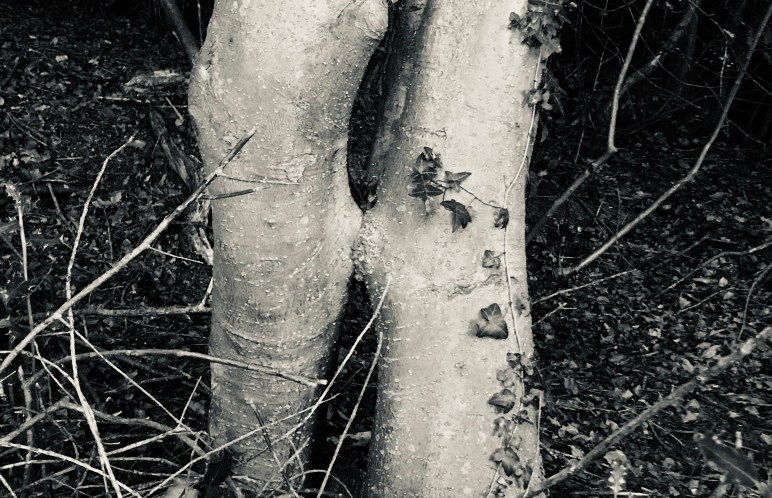
To inosculate

This is how two trees come together as a verb:

The action of wind and weather rubs the

Trunking stems, wears down their hides of bark

Until, shedding the singular, they fix and engraft.

I saw two sycamores – their branches held aloft,

You’d almost think them paused in greeting –

With their bodies joined, creakingly growing.

They knew the trick to living long and well is sharing.

Different species of tree – ash and beech,

Oak and wych – have been known to husband like this:

Fused through lipless kiss. Forgetting separateness.

In this wound, where bark gives way to bark,

There is strength through scarring – a deep tissue spark

Uniting, healing, as if by magic, the other.

Each stripping, cleaving, peeling their barriers back.

Life is in the cracks. You scratch my back and

I’ll scratch yours. They’re stronger than either

Tree was growing singly. Combinedly, as ’twere

A lover’s knot, they forge a burl deadlocked.

When did rubbing become fixed embrace?

Was it a slow relenting over a hard winter once

When one tree, kissingly, cleft to its neighbour?

A mutual surrender to throw their lots in together.

Here they stand, intransigent, statued forever:

Old, wizened couple, leaning one on the other.

They are verbing together: always grafting, busily

working, co-mingling sap in the onrush of Spring –

Harvesting, growing into one another’s rings with age:

Unmoving, yet always sucking face.

This is how to make a craft of symbiosis.

In comparison with trees, a human kiss, so transitory –

A momentary rubbing of lips – is a post-it note

To the story written in a fixed, wooden kiss.

This verbing teaches me to strip my skin

And, rubbed raw of fear, let the light back in.
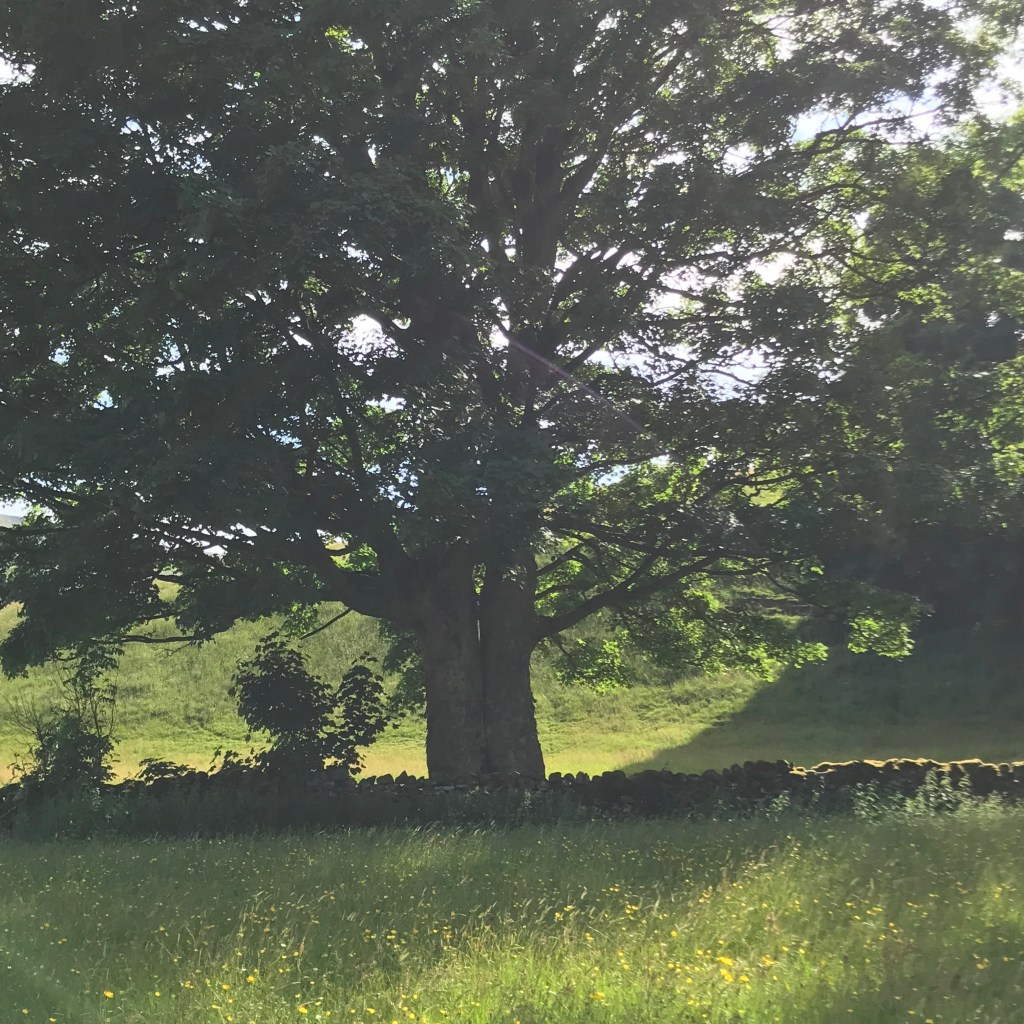
Inosculated sycamores beside the Muker hay meadows, Swaledale, Yorkshire

Potter’s Field

The Potter’s Field is full of bones that no one claims or knows whose ulna or stapes these were: what works they wrought or sounds heard. And no one comes here but the crows to pick it over, scratching at the earth as at a wound; turning over, instead of sherds, pale shards of bone that are twice-buried when thrown in again. Buddy Bolden, he was buried so in New Orleans, forgotten in clay; some women tried as witches long ago; a few pigeon bones muddled withal found their way into that claggy grave. The unquiet excommunicants a righteous Church excised for suicide were here cut off from sanctuary. A child without a name also was disposed of in this way: she they put to work too hard for chapped and little fingers. Orphaned of the world, belonging to none, their dead eyes turned up to sky as they were rolled into the clay mould. All the nameless folk the world forgot are planted deep here in the damp cool ground: all lost, not found. Some too poor to buy a plot to fit their bones before death came for them. A pauper’s grave in Potter’s Field costs nothing.

Here, the massing poor stack deeply in obscurity. There, a jawbone lies uselessly unhinged, undone from any skull it might have cleaved to in life: the teeth stained and marshalled like witnesses. See, a person was this: a kind of man who smacked his chops about his spoon, gnawing it when hunger gnawed at him. This maw’s rictus grin is only half-human, half a story of him.

Fragments. Old bones and histories now locked in trenches potters cut for clay to make their vessels once. The potter’s art made this a tombyard. You do not think the potter has a double craft until you see the fields of pot-holed clay left in their wake – waiting to receive their dead, swallowing them whole in pitchers bottomless and cold. And do you know of the originary field – the one began it all – bought in blood for thirty pieces of a traitor’s silver? Good for nothing but putting away those we do not dare remember. Did Judas hang himself there and slip unremarked into clay, the first to go to a potter’s grave?

I will not think it strange then that no one likes to walk the way beside a Potter’s Field. They rightly fear, who creep away, a fate that brings the world’s lost limbs together in one great grave forever (or at least until the dead shall rise and call to account their dispossessed state). Unfriended, disappointed, unanointed. Those whom no rites ushered on their way. Their strangled voices crowd upon your tongue. Speak for them, the disarticulated vertebrae and cracked pelvic bone that bore a babe once – now infertile: a reliquary for the worm.

So many potters and potters’ fields the world over: the great leveller. There will always be clay to work and fashion whilst the living want new-fangled things, and people always to forget and bury in its awful place. For pity, give not to me a potter’s plot: bury me high up somewhere beneath the starlight. Let me not be exchanged for a clay cup, an oil lamp, a painted pot. Give to me some ceremony when I go, and a clayless memory to keep alive some part of me.